»Participation became framed as a favor rather than mutual solidarity«
Some Hungarian leftists recently went public with criticism of the Free Maja campaign – we asked what was behind it
Interview: John Malamatinas und Jan Theurich
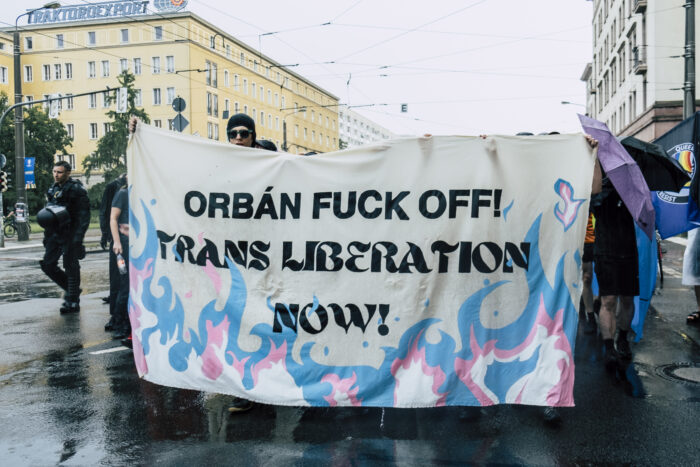
The text »FREE MAJA – Critical reflections on the campaign from Budapest«, penned by Hungarian leftists, was published on an anarchist blog at the end of January and caused quite a stir in German-speaking countries. In this interview, the authors shed light on the background to their criticism of the Free Maja campaign, the political differences in the assessment of the Orbán regime, and explain how they envision international solidarity.
Your statement is signed »Some Anarchists from the so-called Hungary«. Could you briefly introduce yourselves and your work? Are you an organization, a group, or collective?
Some Anarchists from the so-called Hungary: This statement was written by individuals; we are not a formal collective. The radical left scene in Hungary is so small that as soon as we say anything about ourselves, our background or what we do as political work, we will reveal who we are. This zine is intentionally anonymous. The movement lacks serious political discussions about strategies and methods, and by writing some things anonymously, we were hoping not to fall back into personal biases but to engage purely with the presented ideas, not linking them to a certain group or individuals.
Can you briefly summarize your central criticism?
The criticism lies in slippering into the mainstream European agenda, according to which Orbán is the ultimate reason of all evil, and therefore fail to identify the common, transnational roots of what is called »fascism«. The zine highlights how international solidarity can unintentionally reinforce harmful stereotypes and a »savior« mindset, rather than truly supporting communities on their own terms.
How did the incidents of February 2023, when antifascists attacked participants of the Nazi march »Tag der Ehre« (day of honour) in Budapest, influence the Hungarian left and your own work?
The word »antifa« started to appear more frequently in the media, in a negative connotation, both in the pro-governmental and oppositional liberal media. One group was particularly fiercely attacked by governmental media and this certainly caused a lot of individual pain. There was an attempt from the government – which is constantly looking for enemies – to portray »the Antifa« as a group of radicals threatening the whole Hungarian society, however this quickly dwindled. Unlike Germany or Italy, we neither had left-wing armed struggle nor did we have street violence between political groups, so the message simply did not resonate with general social perceptions. Besides all this, there was an attack on a small leftist gathering that probably would not have happened otherwise. And of course, there was much more attention on Hungary from international media, and comrades from German-speaking countries.
Hungary is often described as a »managed democracy«, a kind of »Little Russia«, or as an authoritarian role model for the global front of nationalists. When reading your statement, one might get the impression that, in your view, Hungary does not play any special role within the EU: neither as a pioneer of a European postfascism nor as a particularly authoritarian state apparatus. You even describe this view as a »prejudice« that stabilizes the existing system of domination. What exactly do you mean by that? Isn’t it a fact that the Orbán regime is qualitatively different from other capitalist states in Europe?
Any comparison with Russia is the result of misunderstanding of the Hungarian, the Russian, or both systems. For instance, political repression against the radical left is almost entirely absent in Hungary, the situation in this question is way worse not only in Russia, but also in Greece or Italy and one might now add in Germany. In fact, what we see in Maja’s case is that the Hungarian police and prosecution office are learning their techniques from their German counterparts.
What we are observing today is not so much the return of fascism as a movement, but gradual and global fascisation of politics and the public sphere overall. In his article in ak, Raul Zelik defined five attributes of postfascism: the moral panic against migrants (1), agitating against the »Nutzlosen« (the useless) (2), the fight against protest movements (3), militarisation (4) and antifeminism (5). One could add a few other points, but even this short list shows how little difference there is between Orbán and other European right wing leaders. In fact, the views of Orbán on migration for example – that were so radical back in 2015 – today are the institutionalized policy of the EU.
Orbán’s Hungary is not a fascist nightmare from the 1930’s, it is rather what Friedrich Merz is trying to build in Germany: the demolition of the social system, wholesale privatization, curtailing the rights of trade unions, forcing everyone to work full-time while the healthcare system is kept severely underfinanced and a system that taxes the worker and provides for capital.
Also, we do not see a qualitative difference between the Hungarian political system and that of Fico’s Slovakia, Nawrocki/Kaczinsky’s Poland or Babiš’ Czechia. The main difference is that (for political-economic reasons) Orbán came to power much earlier and could build a more lasting power, partly due to the weakness of its opposition. What we can see today clearly is that the contemporary capitalist world-system successfully produces such political regimes throughout the semi-periphery of the EU and beyond.
Agreed, but isn’t Orbán the pioneer of this development on the right?
The boldness of Orbán, some of his tactics are indeed being used as a model; not just in Europe. But this is only possible because these societies have a lot in common, so similar political strategies are viable. So singling out Orbán does not help a lot in analysing the global spread of postfacsism.
There was a response or counter-statement to your criticism from other Hungarian anarchists in which you are accused of generalizing from individual conversations and personal experiences and of relativizing the regime of Orbán. Are you familiar with this text, and how do you position yourselves in relation to it?
We heard about the text, and we hardly saw anything new in it as we have been having these discussions for years. This counterstatement again shows that the political divide is not between the East and the West, or Hungarian and German comrades, but in how we see the roots of fascism.
A lot of people look at leaders like Orbán and see them as simply evil, as if they were the source of the problem. They make them responsible for the rise of the far-right and fascism. But what if the rise of fascism in Hungary and elsewhere lies in the contemporary capitalist world order? People in semi-peripheral and peripheral countries are left behind by that system, and they look for leaders who promise to push back against globalization, and to protect them.
So in this view, Orbán isn’t the root but a reaction. Politicians like him are riding a wave that the Western-led global order created. If you want to stop the rise of fascism, you don’t just blame the leaders who exploit the anger. You have to look at the system that created the anger in the first place.
You say that the solidarity campaign Free Maja attributes sole responsibility for the »maintenance of inequality, exclusion, and violence« to an »authoritarian anomaly« called Hungary. Where exactly does the campaign express this view?
In no way did we want to say that the campaign was solely responsible for anything. First of all, we want to clarify that we can speak only about that part of the campaign that reaches us, mostly through comrades coming to Budapest for the trials. We did not aim to analyze the strategies and messages of the whole campaign since – from our understanding – it primarily takes place in Germany and directed mostly at the audience there. But when the arguments are uncritically repeated in Hungary, a problem emerges: they reinforce the very framework we are questioning. For example when people from the campaign tell us that the conditions of Hungarian prisons are a reason for the campaign’s advocacy for extraditing Maja. When the discussion takes such directions, one is left to wonder to what extent your comrade is aware of the contemporary global economic order and its consequences.
Comrades supporting Ilaria (again, those who reached Budapest) were, in contrast, very aware of the difference between the ideological tactics and realities. They knew the claim about Hungarian prisons was slippery, but they also knew that for the Italian general public, Hungary is »Mordor«, so the argument would resonate and help her case, regardless of nuances. We see nothing wrong with leveraging these mainstream narratives strategically; but to start taking it literally is shortsighted.
In your statement, you essentially call on the Free Maja campaign to distance itself from attacks on neo-Nazis. What do you hope to achieve from that? Why should a solidarity campaign concern itself with the question of the usefulness or uselessness of antifascist militancy? As far as we know, there is no joint position on this.
This is, again, a misunderstanding. We did not want to call on the campaign to address their position towards antifascist militancy per se but to address the fact that such a term did not even exist in Hungarian circles, that this act was scary and perceived as dangerous for us, to address that a group of people came from Germany to Budapest without thinking through the consequences.
How do you assess the campaign »Stop the Glorification of Nazism!«, which mobilizes people to Hungary every year and which – at least from the outside – seems to be well connected in Hungary?
In 2020, when the cooperation with comrades from Germany had started, the demo managed to gather a few hundred people, which was quite a success. Since then, unfortunately, the number of locals on the demo has diminished. The campaign has never managed to challenge the mainstream opinion that the February fascist hiking and the antifascist counterdemonstration are merely two groups of extremists fighting each other. In fact, the 2023 attacks have strengthened this view.
Why do you think this is the case?
The government managed to pacify the working classes with nationalism, while the professional-managerial class – typically the majority of rally-goers in Budapest – recognizes that the far right is not a threat to their position. In 2020, when the demonstration was at their biggest, the organizers managed to involve many groups beyond the Budapest middle class – but not anymore.
What is the current situation of the Hungarian left overall, and what does concrete local work against Hungarian neo-Nazi structures and the regime of Orbán look like?
Well, the left is small and divided, as everywhere. The regime of Orbán is most probably going to fall this spring and is going to be defeated not by the left but by another sexist, conservative, xenophobic candidate. Few of those who call themselves left decided to support this opposition, and they do it from the sideline using antiauthoritarian, implicitly antifascist arguments. Others who see no point in that are engaged in educational or media projects and try to broaden the »movement«.
In Hungary, few on the left are interested in fighting neo-nazi structures. They are generally seen as insignificant, useful idiots of the regime. Those who do engage in this question organise small scale antifascist events.
What do you hope will result from your criticism? From your perspective, what would constructive cooperation with international solidarity structures look like?
When internationals first joined the February demo against the Day of Honor, many were genuinely interested in Hungary and aware of similar events like Bleiburg in Austria. They came mostly to stand in solidarity against the far-right gatherings in Budapest. Occasionally, we encountered a kind of orientalism – unsolicited advice on how to handle the police or how to shape our commemorations, along with a subtle sense that we were not organized well enough. Still, this was rare. A few years later, the tone had shifted. Participation became framed as a favor – »we came because you asked for help« – rather than mutual solidarity. By the time of the Free Maja campaign, internationals arrived with pre-fabricated answers: Hungary was simply »Mordor«, and Maja needed saving, with little interest in understanding the country or its context.
So first of all, with this zine, we just wanted to say that international solidarity is not a series of solidarity events, I am sorry. It is a really hard job, especially considering that we live in a capitalist world of uneven development, where resources by default are spread unequally, and people’s lives are affected. One needs to learn contexts before judging or especially assuming to know anything. Second, this kind of orientalism is also part of the Hungarian movement. Free Maja graffitis are visible on Budapest streets, but the critical talks around the campaign in Budapest take place only informally. After the publication of the zine, many asked to translate it to Hungarian because many people feel this way but are afraid of criticizing the campaign as »Germany has a big leftist scene« and, obviously, because the campaign aims to support an imprisoned person! So to support local comrades whose voices were unheard, it is also a bit of a hope.
And we are very happy to hear that the zine got quite a few readers in Germany. This sounds great! Thank you, ak, for your interest, too!
You can read the interview in German as well.